The Making of “Wives of Agency” (Progress Update #7)
Note: This is not a trailer, this is just a demo of the prologue and first three years of Catherine’s marriage and reign. In addition, it does not include the programmed checks for critically low stats and game over conditions, which exist, but would not be met by these first 3 years, as the stats cannot be lowered to those thresholds yet.
Progress
As you can see, the game is semi-playable, but no where close to being finished, but there’s still some things that I want to share, I just think by starting out with a quick video showing all negative responses and all positive responses help to show some of the variation that is already inherent in the game.
One of the ways that I’ve begun planning for the game is to create a timeline of events that I want to include in the 23 year long demo:
- 1509 – Coronation
- 1510 – First Stillborn Daughter
- 1511 – Infant Son Dies
- 1512 (Catherine turns 27 years old)
- 1513 – CATHERINE OF ARAGON RULES ENGLAND WHILE HENRY INVADES FRANCE / CATHERINE OF ARAGON DEFENDS A SCOTTISH INVASION. In addition, primary source letter to Henry sending the coat of Arms of the fallen Scottish king.
- 1514 (Henry signs a peace treaty with france and returns to england)
- 1515
- 1516 – CATHERINE OF ARAGON GIVES BIRTH TO A HEALTHY DAUGHTER
- 1517
- 1518 – CATHERINE OF ARAGON’S FINAL FAILED PREGNANCY DROVE HER TO RELIGION
- 1519 – Henry Fitzroy Split
- 1520
- 1521 – ANNE BOLEYN RETURNS TO ENGLAND
- 1522 – ANNE BOLEYN WINS THE ROLE OF “PERSEVERANCE” AT COURT PAGEANT
- 1523 – ANNE BOLEYN IS SECRETELY BETROTHED TO HENRY PERCY
- 1524 – ANNE IS INVITED BACK TO COURT
- 1525 – ANNE BOLEYN BEGINS RECEIVING LOVE LETTERS FROM KING HENRY
- 1526
- 1527 – CATHERINE OF ARAGON IS CONFRONTED ABOUT THE END OF HER MARRIAGE
- 1528 – CATHERINE OF ARAGON REFUSED TO BE SENT TO A NUNNERY / ANNE BOLEYN IS SENT TO HEVER CASTLE
- 1529 – ANNE BOLEYN IS INVITED TO LIVE IN GREENWICH PALACE / CATHERINE OF ARAGON DEFENDS HERSELF AGAINST ANNULMENT / CATHERINE OF ARAGON’S MONKEY HATES ANNE BOLEYN. In addition, primary source letter to daughter Mary.
- 1530 – ANNE BOLEYN READS BANNED BOOKS/ CATHERINE OF ARAGON LOSES HER HOME AND DAUGHTER
- 1531
- 1532 – ANNE BOLEYN BECOMES MARCHIONESS OF PEMBROKE / ANNE BOLEYN’S FINAL PUSH TO BECOME QUEEN SUCCEEDS
- 1533 – ANNE BOLEYN SECRETLY MARRIES HENRY. CATHERINE OF ARAGON’S MARRIAGE TO HENRY IS ANNULLED. Another potential primary source letter to Mary. Potentially end the game with Her final letter to Henry 1535 if her Morale is high enough.
Please excuse the strange capitalization. I actually used placeholders for the events from my timeline, which has all caps event titles. As you can see, there’s a handful of years where I have nothing. And while I would love to include those years and become creative about what goes there, I think I may add a simple placeholder event that does not directly pertain to history, but allows for the student to potentially redirect stats moving forward for instance:
The year is [fill in]. There were no major events this year, but as a Queen it is my duty to perform public works. What public works should I complete?
- Perform Charity [+ Reputation, and include a quick description of Tudor Charity or Catherine’s involvement in this activity]
- Flirt with Henry [+Affection and include a quick description of Henry’s egotism and love of chivalry and courtly love]
- Confess at Church [+Morale, and include a quick description of Catherine’s devout nature]
While it’s not a perfect solution, it would help me by freeing up time to focus on the more intensive years. For instance, in 1509, as you saw in the video of the game, there were two primary sources about the Coronation, and while this was a simpler question: read the source and determine what opinion the writer had of Catherine, I aim to have the questions become more complex and varied towards the end of the game.
You’ll also see in this outline that certain events are in bold typeface. This is purposeful. I am considering in these year creating what I call “splits” where the current levels of Catherine’s stats will inform what path the game will take. While I don’t have the time to be able to create brand new paths, the major way I imagine this taking is as follows:
- In 1519, Henry fathers an illegitimate son, Henry Fitzroy. If Henry’s affection is high, Catherine receives no penalty towards her stats. If Henry’s Affection is low then Catherine is affected with a debuff where each subsequent year, she loses more affection with Henry as his flirtations drift away. (I imagine that each negative stat from a question is five points but the debuff from this event is only 1 point per year, important and urgent, but not immediately game ending for most players. At this time I cannot speak to what the threshold for this change is and even if I did give a number, it is likely to change as the game becomes more permanent and less preparatory.
- In 1525, Henry begins sending love letters to Anne Boleyn. If Henry’s affection is high, then Catherine receives no penalty towards her stats. If Henry’s affection is low, then she is afflicted with a similar debuff. I imagine this threshold to be higher and more difficult to achieve. I also acknowledge that these events are all affection checks so far, but it is what I feel is best in line with the history thus far, and other stats will be important for later events. In addition, at this time I do not intend for these checks to have a positive outcome, I believe that it not only is more historically accurate to only have neutral and negative outcomes, but it also makes balancing the positives that are given from correct choices more important as they are given out less frequently than negatives. There is inherent strategy in the stats being difficult to maintain, though I will test the game playing many different options and try to see how difficult it will actually be. If I had more time I might also ask friends and family to play test to make sure the strategy is still engaging and not impossible feeling.
- The last major split happens in 1529, where Henry asked Anne to move in with himself and Catherine as well as Catherine having to defend herself at the Legatine Council. This year is huge in so many ways, but I intend for there to be a more in depth primary source analysis and multiple questions for student’s to answer about Catherine’s famous speech. In addition, it would be strange to not include a stat check such as the previous events here. I imagine that this would be a three way check for all of her stats to determine the ending:
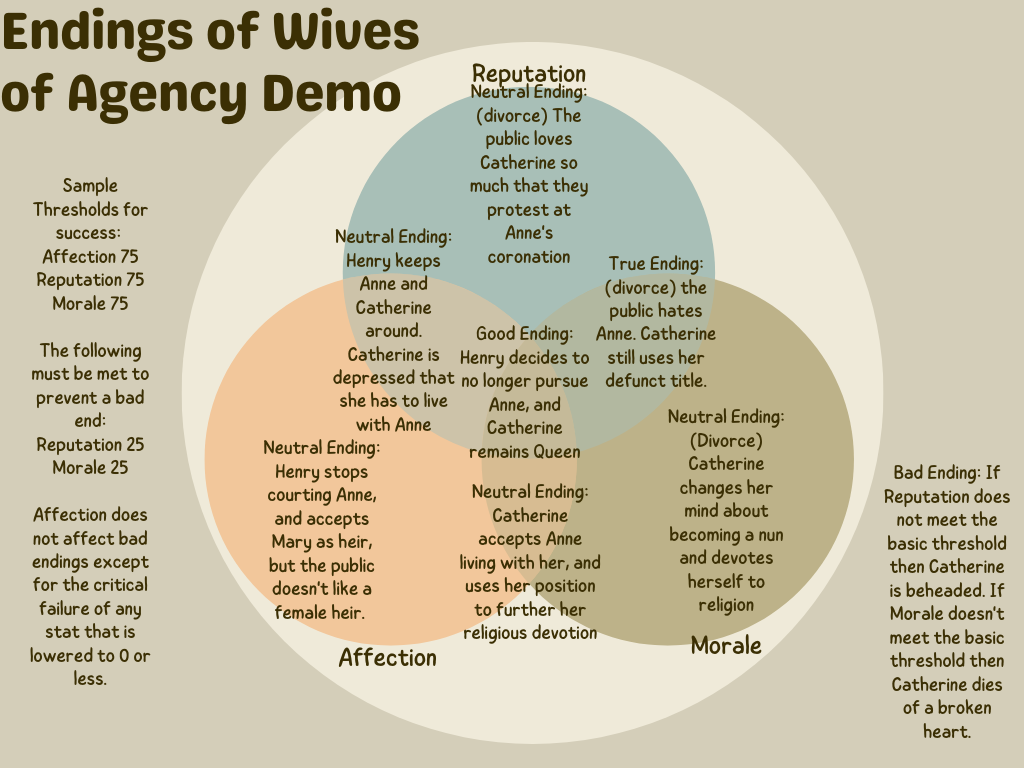
As you can see, there’s potential for every type of ending:
- Bad from critical failure at any point of the game from reaching 0 or less of any stat.
- Bad from not meeting the basic threshold for Reputation: Beheading.
- Bad from not meeting the basic threshold for Morale: Die of Broken Heart (Semi-historically accurate, but not the true end).
- Good from meeting the success thresholds for all stats: Survived.
- Neutral from meeting between one and two of the success thresholds: Either divorced or survived, with drawbacks depending on the stats.
- And a true ending, which ends with a divorce from Henry, but the love of the English people and Catherine’s strong will still intact.
- (Note: I currently do not have an ending planned for the off chance that no thresholds are met, but also no bad endings are triggered, I am still working on a solution to this possibility)
I will admit that divorce or a neutral survival are the most likely of any ending, but they also reflect the most likely options for Catherine based on her specific marriage to Henry. I aim to have every ending also include a description of what actually happened to Catherine when her marriage ended, so students can compare the ending they got to the historical truth.
Challenges
There’s a lot of challenges. You can already see the complexity of the endings. There’s going to already be 10 different endings by what I have planned, or 11 if I count the ending I haven’t figured out yet, but I tried to simplify it by not having the branches mean anything substantial to the plot until the 1529 event, which only leaves 4 years that are not identically structured (and if we’re being honest, they’ll likely all be condensed into a final ending, rather than playing out as other years happen).
Other challenges are those years without major events, but I’ve got an idea that I don’t think is terrible. I’m also concerned that I need to amp up the historical thinking lessons throughout, which may require some play-testing and peer review for me to feel comfortable with it.
The last major concern is the one that I always have: Time. I spent about 6 hours trying to program the three years present after the prologue, in addition to the critical failure game over, and critical stat condition notifications, and making the player stat screen look like Catherine. So on average, it took me an hour to implement each of those features, and the game has got a lot of content left to create and I’ve only got about a month to do it. I think that I’ll be moving slightly quicker now that I have a better understanding of what I’m doing and how the program works, but it’s still very time intensive (but also super fun, one of my favorite school projects I’ve ever done, I think.)
Learning Pedagogy
This week, a lot of what we’re doing is working on our projects, but also learning from other digital projects on how to improve our own. I’ve looked through a handful of the projects and one of my favorite things that I’ve seen (admittedly from a few of them) is that many include a website that includes specific lesson plans and teacher guides to using the project. This is something I have not actually planned for, but want to add to my project, even if it’s fairly simple. My project is a video game. Is it an educational video game? Yes. Is it fun? I’m biased, but I think it’s fun. And a lot of teachers, even if they see that it’s educational, still need to be able to justify the use of the game for the class to their supervisors. I hope that by creating a sample lesson plan using the video game, I will help to create built in justifications for the use of a game in a school setting, and it will also allow me more flexibility to include rich and interesting primary sources about the English Reformation that do not fit neatly into the game in it’s current iteration. I also think that while historical thinking and critical thinking as major themes inside the game, having more ways to work through it on pen and paper, might also help to reinforce these skills with students.
Next Steps
I really need to just buckle down and get more years programmed. I really want this project to turn out well, and it’s actually working very close to how I imagined it would (barring all of the UI, visual design, and voice acting that I would love to include if I had a budget to contract out things like that). I’m very happy with it, I just need to do more, which isn’t always easy with the amount of responsibilities that graduate students have.
