
Learning Digitization Basics with a Mana-tea Infuser
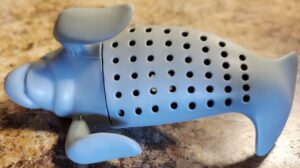
The picture above is what I lovingly call my Mana-tea Infuser. I’m not a coffee or a tea person, I kinda both person, which may sound strange to some. While I love tea for the fancy lattes and sugary iced coffees, I love tea because of it’s calming nature and huge amount of variety. There’s thousands, millions even, of types of tea out there. This Mana-tea is meant for a type of tea known as loose-leaf tea. Most people probably think of teabags or sachets, but loose tea is often fresher, but with the drawback of having to strain it yourself. That’s where the Mana-tea comes in, his cute blue-grey belly is full of holes that keep the tea leaves inside him, but lets all the yummy tea water out. But this blog post isn’t just about tea, or coffee, or any other tasty warm beverage: it’s about digitization.
Digitization is so important in the humanities, as it allows scholars and researchers to use materials that may otherwise be out of reach for them. During my undergrad, I experienced the Covid-19 pandemic while researching for my essay on the LeBaron family. Libraries were closed the public, often forgoing physical material lending, and my dreams of traveling to Brigham Young University to look at the materials in their archive were dashed. What I was able to do however, was use the few materials I was able to get physically, and have others digitized and the digital files sent to me. I got a grant specifically to get a handful of digitized letters between the LeBaron brothers from the archives, which was the closest I could get to a lot of the primary sources I wanted to use. Now imagine that it’s ten, twenty, thirty years earlier, and for some reason you can’t fly halfway across the country to look at the archives for some reason. You’d have no access to any of those materials. In fact, I found out those materials existed due to a digitized archive collection database that was used to find the physical location of each source, so I wouldn’t have even known that they were at BYU, perhaps not that they even existed, without digitization efforts.
Needless to say, I love digital sources, they’re convenient, and much less scary that using the real deal (gloves and acid-free boxes anyone? Intimidating to say in the least). So what can we capture when you digitize something? The easiest things to digitize are two-dimensional, pieces of paper, photographs, maps, etc. In a lot of cases, newer archive materials can just be scanned using a traditional office scanner. Older, more fragile paper documents might need to be photographed instead of scanning. With this, you can get both side of the documents, and for newer texts the writing can be sent through an OCR software in order to get a transcript of the text. OCR’s aren’t foolproof, and sometimes things will need to be transcribed by hand, but it’s still better than having no digital transcript of a document.
Other types of objects are more difficult to digitize. Take our Mana-tea above. Now that I’ve explained his use to you, you probably understand about what size he is (probably small enough to fit in a mug, but with an inner cavity with enough remove for the contents of a tea-bag). You can probably see that he’s a blue-grey color, but sometimes light can be deceiving, so you don’t feel 100% sure about what hex code to use to describe him. You might be able to tell he has a plastic, rubbery, flexible texture to him, but you can’t quite tell. You imagine he smells like jasmine tea, or peaches, or was it chamomile? I can tell you that his little fins hang over the rim of a cup at about a 90 degree angle. But do you really know what he’s like in person, do you know how he would feel when you used him? You probably don’t.
To effectively digitize something like the Mana-tea, it would probably be best with a combination of different digitization methods. One picture might be enough for the gist of what it is, but would more photos be better? What if you could have an accurate 3D model that shows the Mana-tea from every angle and shows every last one of his draining holes. You’d be able to see his cute nostrils on the 3D model after all. What about a video with a demonstration? What about an in-depth description like that used in the alternative text data of the image? Would it help if the description included specific dimensions that showed the scale of the Mana-tea? You’ll never know what is important to future scholars when digitizing something, so you should make it important to note everything that can be noted about it.
“But Cecilia, why would I need a digitized novelty tea-infuser?” You may ask, but the answer is, “You may not, but others might.” The same goes for any other type of artifact. How do you digitize a vintage dress, a car, a house, a sculpture? Written texts, while not easy, are straight-forward, but other mediums require more thought. If you want to work with unique types of primary sources, you’re likely to come across some interesting digitized materials. Will you be offput by a digital video, or a 3D modeled room, by an audio-file of an oral history? Or will you find new an innovative ways to incorporate digitized materials into your research?
(Last Updated 09/22/2022)

Your mana-tee description made it very easy to envision. I agree that it would be interesting to see a 3D mdel.