
Museums and their History
What is a museum? What do you emphasize when you give your definition? Do you emphasize the building itself, do you emphasize the collection of items? Do you image an art museum or gallery, history museum, historic house, science museum, natural history museum, do you imagine an elaborate green house and garden? John E. Simmons, in his book Museums: A History, traces through the definition of museums through history in the first chapter. He starts with Dr. Samuel Johnson’s definition: a “repository of learned curiosities,” (Simmons, 1). I bet that is not what you would have stated: A place for storing strange things that we have interest in. But is that not what a museum is? In history and natural history museums around the world, human remains are on display, and visitors do not even bat an eye that a corpse is on display at a museum. Lots of guests would actually flock to see a mummy in a museum, but the response would be different if that same corpse was on display in a less likely location, like a mall, restaurant, or office building lobby. The same wouldn’t be said for a pretty painting or vase.
There are unknown variables into what consists of a respectable museum display, and what is a respectable space to display it. Not all collections are displayed in museums. Typically, the things displayed are unique specimens, something so old that it’s one of the last remaining specimens of its type, or something that’s one of a kind, or something that belonged to someone important. But even then there are outliers. While museums have existed in one way or another since ancient times, when one thinks of modern museums, it is similar to those founded in the 19th through 20th centuries. Many of which were populated with artifacts from private collectors. For instance, many original collections of the Louvre came from the private collections of nobility executed during the French Revolution (Simmons, 153).
Even many modern museums are furnished with art and artifacts from private collections. This has even caused problems where museums are oversaturated with donations or lendings from wealthy people, who may sway the curatorial efforts of the institution. For instance, museums that primarily have collections from rich people are more likely to display those upper class artifacts than acquire and curate artifacts from lower class communities. Another concern is that many art collectors will only lend their collections to museums with the clause that the art must be displayed, not held in storage, restricting the physical amount of display space for other collections (Taylor).
Museums are not always brick and mortar anymore. The Smithsonian announced in September 2020, the Virtual Online Museum of Art (VOMA), the “First Entirely Virtual Art Museum,” a virtual reality museum filled with born-digital artwork, rather than scanned in copies of physical art (Nalewicki). Other similar museums have also cropped up, as museums either add their collections to the Google Arts and Culture programs or in-house VR programs. Another recent addition is the DataArt IT Museum, which focuses on digitizing old forms of technology, like floppy drives, VHS tapes, and CDroms, while putting them into context with Eastern European Computer Scientists in History (“Digital Museums For Digital History”). When asked about what they believe makes a museum, the creators of DataArt IT Museum responded, “We think it’s the context: Put old dusty hardware into historical, social, or cultural surroundings to explain their historical significance, and the stories come alive,” (“Digital Museums For Digital History”). The limit of a museum is not an old building filled with old objects, it’s what we choose to say about those objects and why.
The connections between MTG and museums are not far-fetched. In fact, MTG has been featured in a handful of museums. The Museum of Play inducted MTG into the Toy Hall of Fame in 2019, though it is unclear if there are any MTG exhibits within the museum (“Museum of Play Magic the Gathering”). The Norman Rockwell Museum has had artist presentations from Tony DiTerlizzi and Donato Giancola, who illustrated cards for MTG (“Magic The Gathering Archives”). Finally, the Museum of Popular Culture (MoPop) has a small exhibit with biographical information about Garfield, cards, and large-scale art of card illustrations (“Magic the Gathering Cards Depict Art Over Time”). Of these, the only one that appears to have physical cards on display is the exhibit at MoPop. In addition, while not MTG specific, Evansville Museum in Indiana hosts a semi-regular special event at the museum called “Geek Con,” which in typical comic book convention style, is an exposition that includes specialty educational lectures about the history of geek culture, as well as hosting vendors' rooms, local celebrity meet-and-greets, and other activities (“Get Your Geek On!”). The history of MTG likely wouldn’t be shunned away from such an event.
If a museum is a “repository of learned curiosities,” what prevents your private collection of geek niche culture from being a museum? One of the biggest hurdles for your collection becoming a museum is the widely accepted rule that museums must be at least partially public, something that your collections of plains, mountains, swamps, islands, and forests likely isn’t public, probably stored away in deck boxes or binders full of card protectors. Now, you don’t need to create a physical space for your collection to inspire the public, after all this is the digital age. Website domains typically cost less than fifty dollars a year, and there are a plethora of tools to create websites with ease. (This website is from Reclaim Hosting, using Wordpress and Omeka.) The benefits of putting your collection online are not just for the goodness of museums and the public, but there are also personal benefits for digitizing your MTG collection.
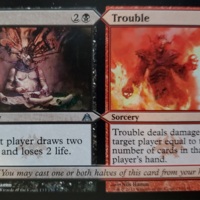
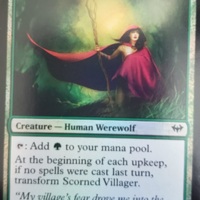

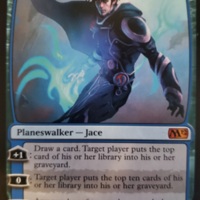
Note: The cards chosen for this page all have a semi-unique aspect to them:
- Toil/Trouble, while it appears to be an image of two cards is actually two cards printed on one piece of card stock. This is not a misprint, Toil/Trouble is deliberately designed such that differing mana costs would give the card drastically different effects.
- Scorned Villager is a double side card. Scorned Villager can transform into the card "Moonscarred Werewolf" which replaces the traditional brown cardback.
- Hamletback Goliath's icon on the middle-right of the card does not point to a specific expansion, as most cards do. Instead this is a unique signifier only used for limited release promotion cards.
- Jace, Memory Adept is the only Planeswalker card in Cecilia Ward's collection. Planeswalker cards are much stronger than typical creature cards with unique effects. When they were first released, Planeswalkers were advertised as being ultimate wizards of their corresponding colors.