Fun Facts and Reflection
These facts did not feel as if they fit well enough into the written aspect of this project, so I thought adding them to my reflections section was fitting enough, especially for a project that does not mesh well with footnotes, my typical style of citation.
- Richard Garfield, creator of MTG, has a PhD in Combinatorial Mathematics from Penn.
- Bob Ross, the American painter, had his artwork posthumously used for limited availability land cards as part of the “Happy Little Gathering” set for “Secretversary 2020.”
- A collector’s edition of the famed “Black Lotus” card is being reprinted for MTG’s thirtieth anniversary.
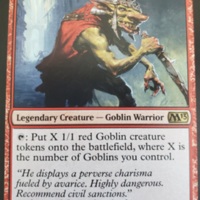
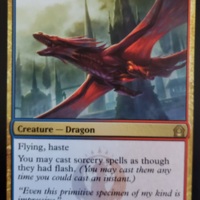
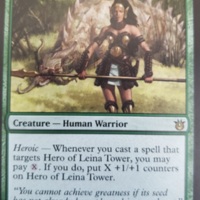
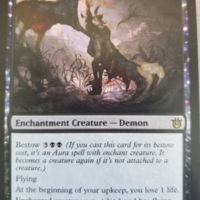
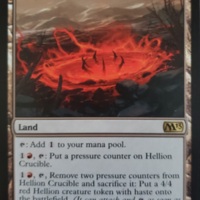
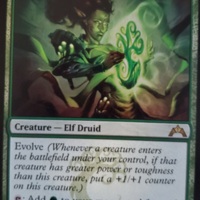
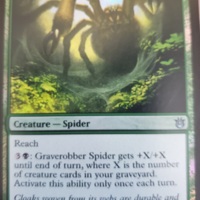
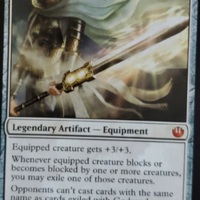
This project is only a figment of what I had previously imagined. Like all academics, I had grand ambitions: I set out with the idea of digitizing my entire collection (over a thousand cards), which quickly became five-hundred, three-hundred, one-hundred, and finalized as all my rare, interesting, or shiny cards, which was still over fifty cards. All photographs, metadata, and transcriptions of the cards were done by hand by myself, which I knew would be time consuming, but did not imagine it was as time consuming as it actually was. Then when it came to actually working on the research and development of the project, I discovered that very few academic sources on MTG existed in the humanities (most of the work I found on MTG was psychology or mathematics related). Another pitfall of my sources is that while I digitized my cards, they serve as little more than visual interest or an example of digitization. My collection is not nearly rare enough for there to be things to say about my individual cards, at least more than a surface sentence or two.
Like all digital humanities projects, I experienced technological issues: one afternoon, spending nearly four hours struggling to get Omeka to accept my CSV file, enlisting my computer-scientist parents, and another pair of helping hands, just to discover Omeka didn’t accept image attachments that had a space in the title of the file, leading me to hand correct the names of the files in both the CSV file and the website Dropbox files.
I also dealt with aesthetic issues. In many cases, I felt like the Exhibit Builder plug-in for Omeka was very limited aesthetically, and it was difficult to lay out the information and cards in a way that looked visually pleasing.
Due to the materials I could find related to my topic, it often seemed as if I were completing two separate projects: one on the history of MTG and how to digitally preserve MTG collections, and one on how museums were formed and interact with private collections. The vast majority of my sources had no obvious overlap, which made the project more complicated than originally intended.
When it came to finalizing the project, I felt that I had run out of things to say, that my topic, while broad, was still too narrow to include more research on it while still being concise. While I enjoy the topic of the project, I don’t think it has much room for expansion. In addition, I am not sure Omeka was the correct choice. While it made my online archive of cards flow well, the exhibit tool was a bit restricting.